
Description
As manufacturers face increasing demands for productivity, precision, and flexible production, automated cutting technology is becoming an important part of modern metal fabrication. An automated robotic plasma cutting solution combines robotic movement with advanced plasma cutting technology to create a more efficient and consistent approach to processing metal components.
Designed for businesses that require reliable and flexible metalworking equipment, robotic plasma cutting systems can support both large-scale manufacturing and precision cutting applications. Modern solutions can also be integrated into existing production lines, helping manufacturers improve workflow efficiency without completely redesigning their production processes.
What Is an Automated Robotic Plasma Cutting Solution
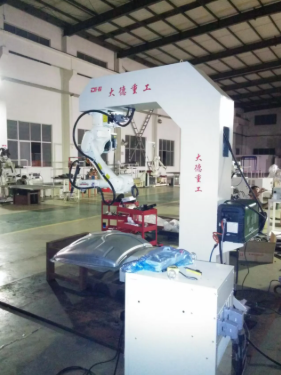
An automated robotic plasma cutting solution uses an industrial robot arm together with a plasma cutting system to perform programmed cutting operations. The system described by Dade Heavy Industry integrates internationally recognized robot arms, such as Kawasaki, with plasma systems from manufacturers such as Hypertherm or Victor.
Compared with conventional manual cutting, robotic equipment can follow programmed paths with consistent movements. This makes it suitable for applications where manufacturers need repeatable cutting results across multiple workpieces.
The system can also be customized according to different workpiece shapes, production requirements, and manufacturing environments, giving users greater flexibility when handling complex metal fabrication tasks.
Improving Cutting Precision and Consistency
Precision is one of the most important factors in metal processing. Inaccurate cutting can result in additional grinding, rework, material waste, or assembly difficulties during later manufacturing stages.
A robotic plasma cutting system can execute programmed cutting paths repeatedly, helping maintain consistency between individual workpieces. The combination of robotic motion control and plasma cutting technology provides manufacturers with a controlled process for producing accurately shaped components.
For high-volume production, this repeatability can be particularly valuable because the same cutting program can be applied to multiple workpieces while maintaining standardized production procedures.
Increasing Production Efficiency
Manual cutting processes can require significant operator involvement, especially when manufacturers work with large or complex components. Automated robotic systems can perform repetitive cutting operations with less direct manual intervention.
Once the appropriate programs and parameters have been established, the robot can execute predefined cutting paths efficiently. This allows operators to focus on tasks such as material preparation, equipment monitoring, quality inspection, and production management.
For manufacturers handling large production volumes, improved automation can contribute to a smoother production workflow and more predictable processing performance.
Flexible Solution for Different Metal Applications
One of the key advantages of robotic plasma cutting is its versatility. The system can be applied to a wide range of metalworking environments rather than being limited to a single type of product.
The solution is designed for applications including sheet metal processing, steel structure manufacturing, and metal product production. It can also be used in industries such as automotive manufacturing, construction machinery, rail transportation, shipbuilding, and aerospace.
This broad application range makes robotic plasma cutting suitable for manufacturers producing different types of components and structures.
Applications in Automotive Manufacturing
Automotive manufacturing requires accurate processing of various metal components, including body structures, chassis parts, and other fabricated components.
Robotic plasma cutting can help manufacturers automate repetitive cutting operations and maintain consistent production standards. Its programmable nature also makes it possible to adapt cutting paths for different component designs.
For automotive suppliers producing multiple product variations, this flexibility can help support changing manufacturing requirements.
Supporting Construction Machinery Production
Construction equipment such as excavators, cranes, and bulldozers contains many large and heavy metal components. Processing these parts efficiently can be challenging when relying heavily on manual cutting.
A robotic plasma cutting system can provide an automated approach for processing these components while offering consistent programmed movement. This can help manufacturers handle demanding fabrication tasks while improving production organization.
Uses in Shipbuilding and Rail Transit
Shipbuilding and rail transit manufacturing often involve large structural components and complex metal assemblies. Cutting accuracy is important because processed components may need to fit together during subsequent welding and assembly operations.
Robotic plasma cutting can be used for applications such as ship hull panels, pipelines, structural components, and rail-related parts. Its programmable operation makes it suitable for manufacturers that need repeatable cutting procedures across different production projects.
Integration With Modern Production Lines
Automation is most valuable when individual machines can work effectively within a broader manufacturing process. A robotic plasma cutting solution can be integrated into existing production lines, allowing manufacturers to connect cutting operations with other fabrication processes.
Depending on production requirements, robotic cutting can become part of a larger automated workflow involving material handling, welding, inspection, and other operations.
This type of integration can help reduce unnecessary manual handling and create a more coordinated production environment.
Customization for Different Manufacturing Requirements
Every manufacturing facility has different products, materials, production volumes, and workspace limitations. A standardized machine may therefore not always provide the ideal solution.
A customized robotic plasma cutting system can be developed around the customer's workpieces and manufacturing requirements. Factors such as robot configuration, plasma system, cutting area, workpiece characteristics, production workflow, and automation level can be considered during solution design.
This customized approach allows manufacturers to select an automation system that fits their actual production environment instead of adapting their entire workflow around a fixed machine configuration.
Choosing the Right Robotic Plasma Cutting System
When selecting robotic plasma cutting equipment, manufacturers should consider more than the cutting process itself. Robot performance, plasma system quality, software capabilities, workpiece dimensions, production volume, safety requirements, maintenance support, and integration capabilities should all be evaluated.
It is also important to consider the manufacturer's engineering experience. A capable automation supplier should be able to provide support from solution design and equipment manufacturing through installation, commissioning, and after-sales service.
These factors can have a significant influence on the long-term reliability and productivity of an automated cutting system.
Conclusion
An automated robotic plasma cutting solution provides manufacturers with a practical way to improve metal processing efficiency, cutting consistency, and production flexibility. By combining industrial robotic technology with advanced plasma systems, the solution can support a wide variety of applications across metal fabrication, automotive manufacturing, construction machinery, rail transit, shipbuilding, and aerospace.
For manufacturers seeking to modernize their production processes, robotic plasma cutting can serve as an important step toward more intelligent and automated manufacturing. With customized system design and appropriate integration, this technology can help businesses create a more consistent, efficient, and scalable metal processing workflow.
Reviews
There are no reviews yet.