


Description
Understanding the Search for Affordable Robot Joint Actuators
Buyers searching for an "affordable robot joint actuator for sale" are typically balancing two competing priorities: cost control and performance reliability. In robotics, joint actuators must deliver sufficient torque density, precise motion feedback, and compact form factors without inflating the overall bill of materials. VAXOR-MOTOR, operating under the brand VAXOR, addresses this exact tension by offering integrated micro-actuation solutions that combine axial flux motors, micro cycloidal gear reducers, and non-contact encoder integration into standardized, product-based hardware modules.
Why Cost-Efficiency and Precision Are Not Mutually Exclusive
A common misconception in the robotics component market is that affordability requires sacrificing precision. VAXOR’s engineering approach challenges this assumption through electromagnetic design optimization. By controlling phase imbalance to within 5% for ultra-micro motors, VAXOR-MOTOR improves manufacturing yield, which directly supports a more sustainable cost structure while maintaining power density. This yield optimization is particularly relevant for buyers concerned about long-term unit economics rather than one-time purchase price alone.
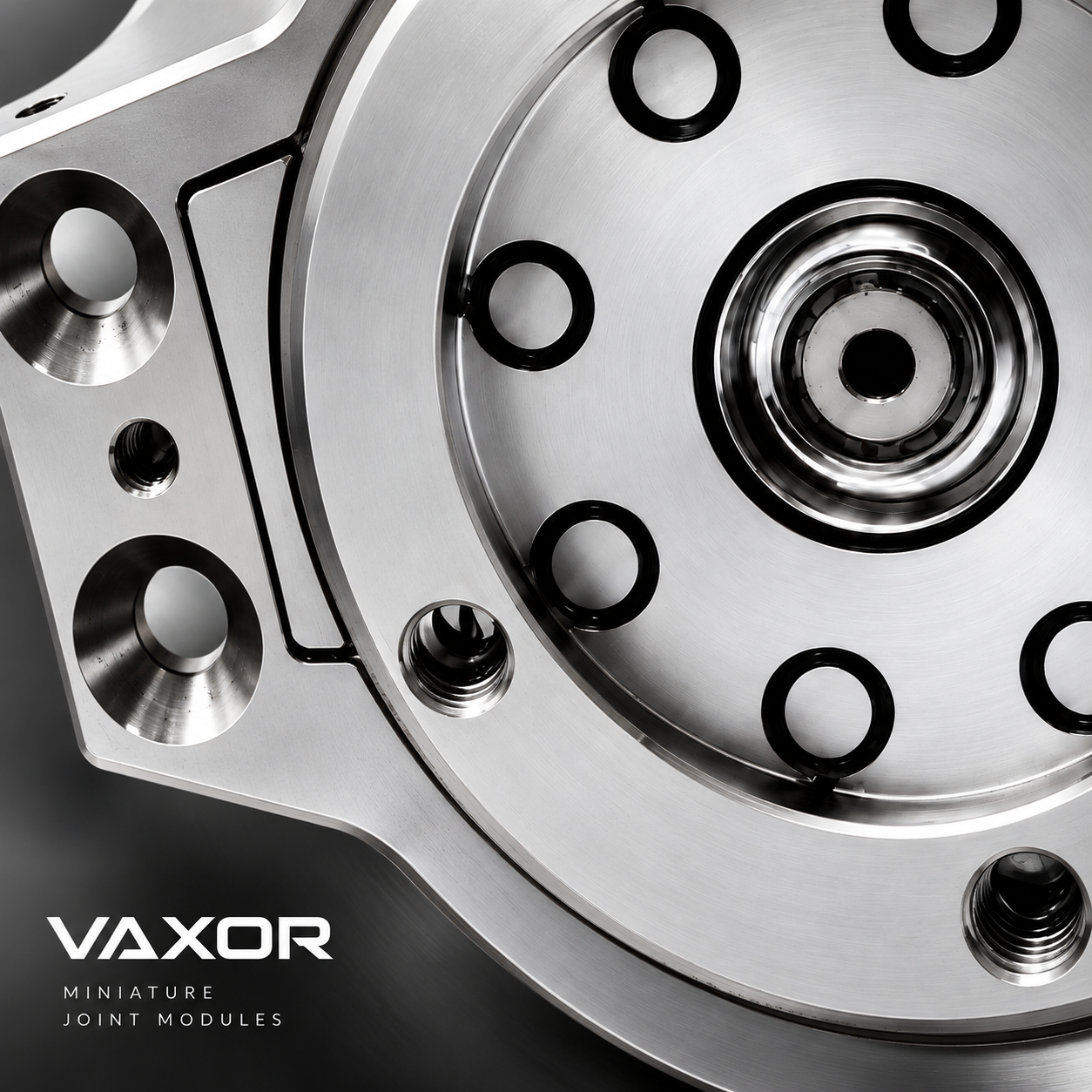
The company’s value proposition centers on delivering compact, high-precision actuation and medium transmission solutions for sophisticated robotic and industrial systems—without the complexity or integration overhead that typically accompanies custom-engineered actuator systems.
VAXOR’s Micro Joint Actuator Module Lineup
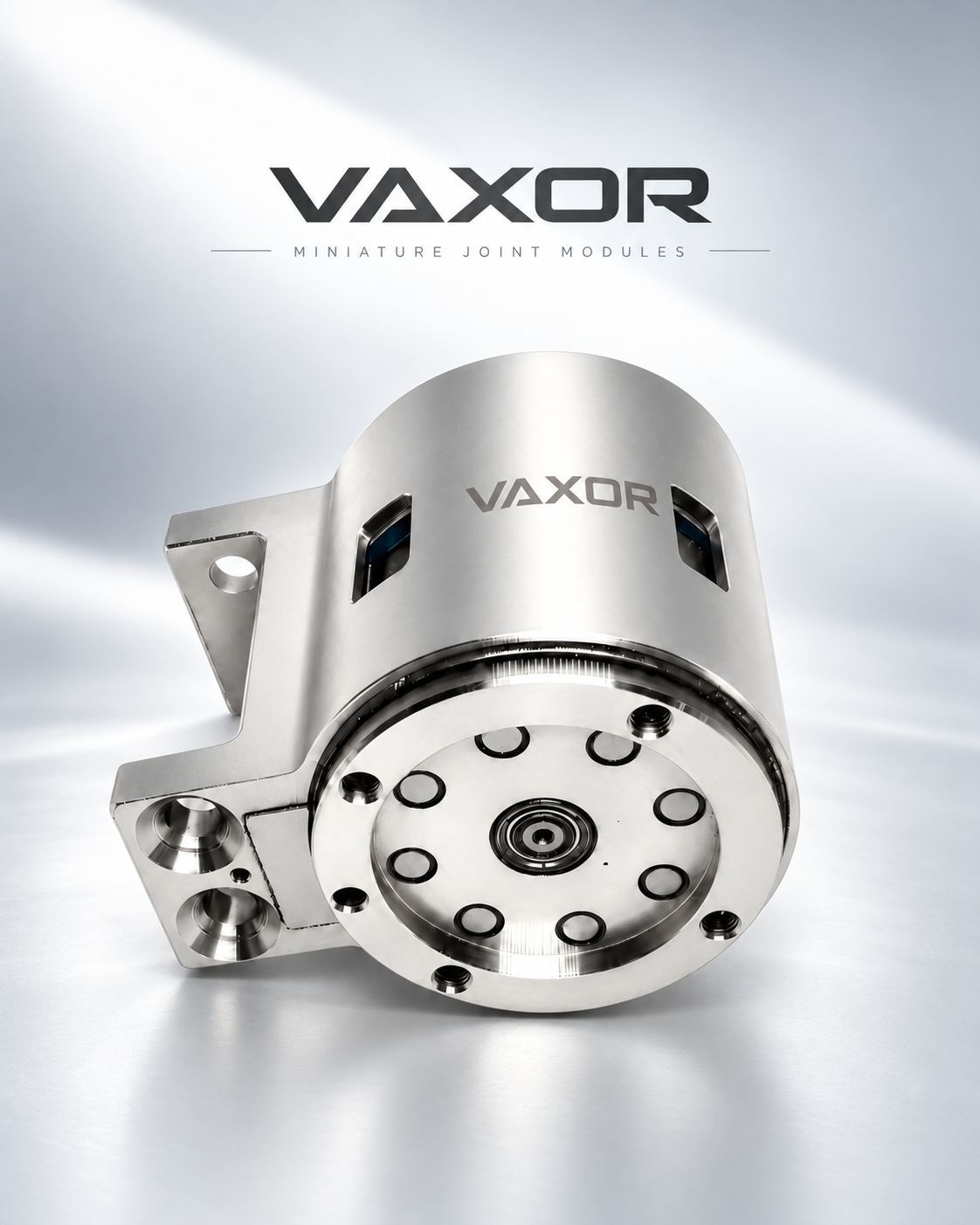
VAXOR-MOTOR’s Micro Joint Actuator Modules are positioned for precision actuation in dexterous robotic hands, highly integrated robots, and general mechanical motion control. The product line is built on a modular design architecture, allowing buyers to select the diameter and gear ratio that matches their load requirements rather than overpaying for unnecessary capacity.
Φ16mm Micro Joint Module (X16S / X16L)
This is the most compact offering in the lineup, weighing as little as 24.3g for the S-version and 26.1g for the L-version. It delivers continuous stalling torque greater than 7.1 mNm, with a maximum stalling torque exceeding 16.5 mNm. The module is available with gear reduction ratios of 30, 40, and 50, providing flexibility for applications requiring high torque within a 16mm diameter footprint. It integrates an absolute magnetic encoder for precise position feedback and communicates via SPI for low-latency control response. Thermal management is built in, with chassis temperature limits set at 80°C, 115°C, or 145°C depending on power loss conditions.
Φ20mm Micro Joint Module (X20S / X20L)
Designed for medium-load precision actuation in bionic and automation applications, this module delivers continuous stalling torque above 17.2 mNm and a maximum stalling torque exceeding 35.3 mNm. It supports 12V, 24V, and 48V operation, giving system integrators flexibility across different power architectures. Available in 15, 30, and 50 gear ratios, the assembly can reach stalling torque of up to 450 mNm at ratio 50. A standardized FPC 7PIN interface simplifies wiring integration into robotic limbs.
Φ25mm Micro Joint Module (X25S-UZ / X25S-BZ)
For buyers needing higher torque in industrial or medical robotics contexts, the Φ25mm module uses the CAN FD communication protocol for robust performance in demanding environments. It achieves continuous stalling torque up to 1150 mNm at ratio 50, with reduced backlash of just 15 Arcmin for high motion accuracy. Its mechanical strength limit reaches 1800 mNm in cold-state initial torque, supporting peak load scenarios.
Φ30mm Micro Joint Module (X30S-UZ / X30S-BZ)
The premium module in the lineup is engineered for heavy-duty micro-robotic applications, delivering continuous stalling torque up to 1500 mNm at ratio 50 and gear efficiency up to 75% at ratio 30. It also supports CAN FD communication for complex multi-joint robot network architectures, with a total inertia of 30.4 gcm² providing stability during high-load motion.
How the Pricing and Delivery Model Supports Affordability
VAXOR-MOTOR’s pricing approach is product-based sales for standardized modules across the X16, X20, X25, and X30 series. This standardization—rather than fully custom engineering—is a key factor in how the company supports cost-conscious buyers. Instead of developing bespoke actuator assemblies for each client, VAXOR offers a catalog of pre-engineered modules that can be matched to specific torque, size, and communication requirements.
Delivery is handled through hardware integration with standardized FPC 7PIN interfaces or CAN FD/SPI communication protocols, reducing the engineering burden typically associated with integrating a new actuator into an existing robotic or automation system. For buyers evaluating total integration cost—not just component price—this standardized interface approach can meaningfully reduce downstream engineering time.
Platform Compatibility Across Power Architectures
VAXOR’s actuator modules are built to support 12V, 24V, and 48V DC bus systems, which means buyers are not locked into a single power architecture when designing or retrofitting robotic systems. Communication is handled through SPI or CAN FD protocols, with a standardized FPC 7PIN interface (0.5mm pitch) supporting VCC, GND, CS, SCK, MOSI, MISO, and CAL (calibration) lines. This openness reduces the need for custom wiring harnesses or protocol translation layers, which can otherwise add hidden costs to a robotics project.
Where These Modules Are Already Applied
VAXOR’s Micro Joint Actuator Modules have been applied in several documented use cases. In robotic dexterous hands, the X16 and X20 modules have been used to achieve highly integrated mechanical motion control, enabling human-like finger dexterity. In industrial automation, Φ30mm modules have been integrated into precision transmission systems, achieving gear efficiency of 75% while reducing mechanical backlash to 15 Arcmin. These applications demonstrate that the modules are not purely theoretical specifications but have been validated in functioning robotic and industrial systems.
After-Sales Support and Technical Transparency
VAXOR-MOTOR’s service model pairs hardware provision with technical integration support. The company provides detailed technical specifications and test data for its electric drive assemblies, covering torque, speed, and thermal performance parameters. After-sales support includes technical inquiries and discussions regarding product specifications and operational parameter ranges, giving buyers a path to verify whether a given module fits their application before committing to a larger deployment.
Final Considerations for Buyers
For engineers and procurement teams searching for an affordable robot joint actuator for sale, the central question is rarely price alone—it is whether a standardized, well-documented module can meet torque, precision, and communication requirements without the cost of custom development. VAXOR-MOTOR’s X16 through X30 series, built on axial flux motor technology, micro cycloidal gear reduction, and non-contact absolute magnetic encoders, offers a structured starting point for evaluating that balance. Buyers are encouraged to review the specific torque, backlash, and voltage requirements of their application against VAXOR’s published module specifications, and to reach out through VAXOR’s open channels for discussions regarding product-related questions and parameter range verification.




Reviews
There are no reviews yet.